Last call Symposium ‘Abstract Concepts’

Abstract Concepts: Debating Their Structure, Processing, and Modeling.

Date: 18-Nov-2016, Amsterdam, The Netherlands.

https://abstractconceptsnet.wordpress.com/

Description
On which dimensions of meaning do abstract and concrete concepts differ? How does perceptual experience affect abstract concept processing and representation? What is the role of language in shaping and indexing the content of concrete vs. abstract concepts? How and in which contexts are abstract concepts understood through metaphors? Abstract concepts are a controversial and widely debated topic, within the theoretical discussion about the embodied vs symbolic nature of language and meaning. The aim of this project is to bring together current views about the structure, processing, and modeling of abstract concepts.

Program
8 eminent scholars have been invited to Amsterdam to discuss the nature, structure, processing, and modeling of abstract concepts in various disciplines. During the symposium the panelists will present in turn their view and will receive structured comments (prepared in advance) from their peers. A general discussion among all panelists and the audience will follow.

Invited Keynote Speakers and 
Provisional titles
Prof. Friedemann Pulvermueller – Concrete mechanisms for abstract meaning
Prof. Gun Semin – The place of metaphors in the order of things
Prof. Piek Vossen – Granularity and identity of event descriptions
Dr. Diane Pecher – Curb your embodiment
Prof. Max Louwerse – Language statistics explain conceptual processing
Prof. Alessandro Lenci – The Emotions of Abstracts: A Distributional Semantic Analysis Prof.
Ken McRae – Situations, perceptual information and abstract concepts
Prof. Gabriella Vigliocco – Learning and processing abstract concepts: the role of language and the role of emotion

Call for Papers
Given the structure and program of the symposium, with 8 keynote speakers, submissions are welcome (and encouraged!) for poster presentations. Posters will be displayed on the conference venue for the whole day and actively discussed over the lunch break, which will take place at the conference venue.

Applicants are asked to submit (max.) 250 words abstracts to M.M.Bolognesi2@uva.nl.

Registration info can be found on the symposium website: https://abstractconceptsnet.wordpress.com/https://abstractconceptsnet.wordpress.com/

Submission deadline (extended): 30th September
Notification of acceptance: 3rd  October
Symposium date: 18th November

The event is organized by the COGVIM project team (EU Marie Curie IEF, awarded to Dr. Marianna Bolognesi – n° 629076) and sponsored by ABC Amsterdam Brain and Cognition, Network Institute, and KNAW Dutch Royal Academy of Science.

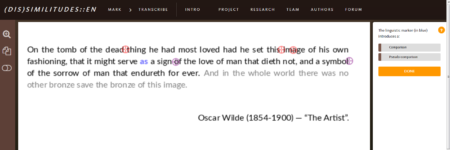
Identify comparisons and similes online!

The Informatics Laboratory of Paris 6 and The Observatory for Literary Life invite you to participate in their crowdsourcing research project.

Read and identify comparisons and similes in 19th and early 20th century
literary texts. Have fun and help researchers’ work in digital humanities!

Get Started! http://dissimilitudes.lip6.fr:8181/

Review of Metaphor in Specialist Discourse

Nina Julich, Research Associate at Universität Leipzig (Germany), reviewed Metaphor in Specialist Discourse (2015) by Berenike Herrmann and Tony Berber Sardinha. This book is part of the book series Metaphor in Language, Cognition, and Communication.

You can read the review here!

Albert Katz visits Metaphor Lab

On July 7, 2016, Prof. Dr. Albert Katz (Western University, Canada) visited the Metaphor Lab for a small-scale symposium in his honor, hosted by Dr. Christian Burgers.

Dr. Katz delivered the opening talk entitled “Structural and social aspects of metaphor (with side trips to irony and puns)”, in which he made a distinction between cognitive (‘structural’) and social-psychological (‘social’) studies into figurative language conducted in his lab. Dr. Katz mentioned both some of his classic studies, as well as new (and unpublished) studies.

Other presentations were delivered by members of the Metaphor Lab and staff of the Department of Communication Science at Vrije Universiteit. Amber Boeynaems and Britta Brugman discussed two systematic reviews they recently conducted on metaphorical framing on political communication. Marianna Bolognesi presented the results from her Marie-Curie funded project CogVIM and showed how linguistic and visual metaphor differ in the kind of similarities they evoke. Camiel Beukeboom gave his perspective on the role of figurative language in stereotyping, and presented new empirical results on the Irony Bias in relation to stereotype formation. Kiki Renardel de Lavalette presented a comparison of using two corpus-analytic methods to test Lakoff’s Theory of Moral Reasoning. The symposium was closed by Christian Burgers who talked about the quantitative results of his corpus analysis on figurative framing in news discourse (conducted as part of his NWO VENI project).

IMG_4336

IMG_4341

First announcement Winter School

First announcement 

Metaphor Lab Amsterdam
Winter School 2017 

Metaphor identification and analysis

Sunday 22 Jan – Friday 27 Jan 2017

After four previous successful events since 2012, the Metaphor Lab Amsterdam is delighted to announce a new edition of our summer/winter schools, this time in the fourth week of January 2017—the school is piggybacked on to the LOT Dutch Research School in Linguistics Winter School in the preceding two weeks. Metaphor Lab Schools are meant for PhD students and young post doc researchers who are engaged in metaphor research in language, cognition, communication, and discourse. Our goal is to offer advanced training in metaphor identification and analysis according to internationally recognized standards. 30-40 participants per school come from all over the world and receive an intense academic experience.

The format of this school will differ from previous editions. We will hold four special interest groups, each under the guidance of one specialized tutor, who will do work together including reading, discussion and research in a specific theme. Each group will work on its own and do a final presentation on the Friday. Apart from this, we are looking into the possibility of organizing a number of general plenary lectures during the week, and we will often go out together in the Amsterdam evenings.

The themes and tutors are the following:

  1. MIPVU – Tina Krennmayr/Susan Nacey: focus on linguistic metaphor identification in discourse
  2. VisMet corpus – Marianna Bolognesi: focus on visual metaphor identification, analysis, and crowd sourced tags
  3. The five step method – Gerard Steen: focus on linguistic, conceptual and communicative metaphor identification in uttterances
  4. Metaphor and argumentation – Jean Wagemans: focus on metaphors as implicit arguments and argumentation via metaphor

Each group will allow for a maximum of 10 students. Detailed goals, contents, methods, and end products will be announced later.

There will be a modest registration fee (200 euros per participant), and travel, accommodation, and food will be at your own expense. We are looking into possibilities for financial aid for applicants with limited resources, upon request.

At this moment we would like you to save the dates, more information will be posted at the end of August.

HIP: a new Hyperbole Identification Procedure

Christian Burgers, Britta Brugman, Kiki Renardel de Lavalette and Gerard Steen just published their article ‘HIP: A method for linguistic hyperbole identification in discourse’ in Metaphor and Symbol:

This article introduces the Hyperbole Identification Procedure (HIP), a first systematic method for identifying linguistic hyperbole in discourse. We start by comparing existing definitions of linguistic hyperbole. Based on the commonalities shared by these definitions, we provide our operational definition of hyperbole as “an expression that is more extreme than justified given its ontological referent.” The next section argues why it is useful to identify hyperbole, as with metaphor in Metaphor Identification Procedure Vrije Universiteit (MIPVU), at the level of lexical units, and subsequently introduces the steps of HIP. We follow up with two sample analyses of HIP in practice. First, we show how to unitize and analyze one complete sample sentence. Second, we present sample analyses of a number of selected cases. Then we present data showing that HIP can be reliably applied to a sample corpus of Dutch news texts. We end with discussing applications and implications of using HIP in corpus research.

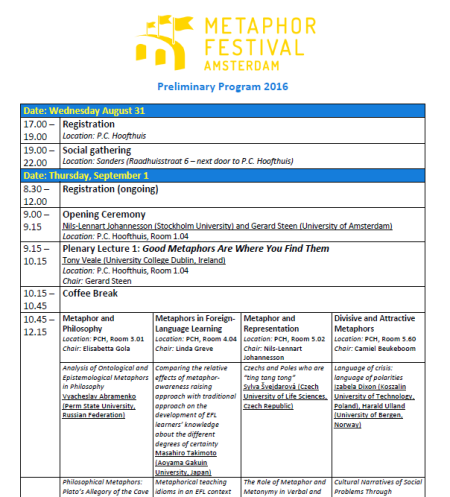
The preliminary program Metaphor Festival 2016 is online!

The preliminary program for the Metaphor Festival 2016 is online.

You can still join the festival as a participant from Wednesday 31 August – Saturday 3 September by filling in the registration form!

Looking for an accommodation in Amsterdam? Check out our accommodation suggestions.

1 4 5 6 7 8 17